

The File Transfer Protocol (Ftp) Uses Which Transport Protocol, Tcp Or Udp?
SPLUNK Training WITH Existent-Time LAB Access
TCP (Transmission Command Protocol):
The translation control protocol (TCP) is just a connection-oriented, reliable protocol. TCP explicitly defines connection establishment, data transfer, and connectedness tear-downwards phases to offer a connexion-oriented service. TCP uses a combination of GBN and SR protocols to offering reliability. To achieve this goal, TCP uses checksum, retransmission of lost or corrupt packets, timers, etc. TCP is the about frequent ship-layer protocol on the internet.
Services offered by TCP:
1) Process-to-process Communication – TCP provides process-to-procedure communication, i.east, the transfer of information that happens between private processes executing on end systems. This is washed by exploiting port numbers or port addresses. Port numbers are 16 bits long which supports identify which procedure is sending or receiving data on a host.
2) Stream Commitment Service –TCP is really a stream-oriented protocol. It allows the sending process to provide data as a stream of bytes and allows the receiving process to obtain information equally a stream of bytes. TCP creates an environs where the ii processes announced to exist connected by an imaginary "tube" that carries their bytes beyond the Internet. The sending process produces (write to) the stream and the receiving process consumes (read from) it.
iii) Full-Duplex Communication – TCP offers a full-duplex service, where data tin can menstruum in both directions at the exact same time. Each TCP endpoint so has its sending and receiving buffer, and segments move around in both directions.
iv) Multiplexing and Demultiplexing – TCP performs multiplexing at the sender and demultiplexing at the receiver ends as several logical connections could be established between port numbers over an actual connection. However, TCP is really a connection-oriented protocol, an association must be established for each pair of processes.
5) Connectedness-Oriented Services – TCP is really a connection-oriented protocol. When a process at site A actually wants to send and receive data from another process at site B, the next three phases occur :
- The 2 TCP's ready up a logical connexion betwixt them.
- Information are exchanged in both directions.
- The bond is terminated.
There is no physical connection. TCP creates a stream-oriented temper wherever it accepts the responsibility of delivering the bytes to the other website.
vi) Reliable Service – It is actually a reliable protocol. It uses an acknowledgment mechanism to test to safe and audio inflow of data. As well, it uses congestion control mechanisms.
TCP Connections :
The TCP connexion is logical, non physical. It operates at an increased level. It uses the services of IP to supply individual segments to the receiver, however, information technology controls the bail itself. If a segment is lost or corrupted, it's retransmitted.
In TCP, manual requires 3 phases:
- Connection Establishment
- Information Transfer
- Connexion Termination
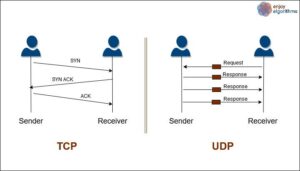
The transmission control protocol requires establishing a link via a three-way handshake before transferring data packets from the server to the client. The iii-manner handshake process, which starts with the substitution of SYN, SYN-ACK, and ACK messages (known as flags) betwixt these entities, helps to make sure that a reliable connection is created between them. The three messages are the next:
- SYN — synchronize
- SYN-ACK — synchronize-acknowledgment
- ACK — admit
Once that connection is established, each segment of data that is sent from the client to the server is accompanied by an ACK flag to verify receipt of the info packet.
Advantages of TCP:
- It helps one to found/ready upward a link between several types of computers.
- It operates independently of the operating organization.
- It supports many routing protocols.
- Information technology enables internetworking between the organizations.
- TCP/IP model has a very scalable client-server architecture.
- It could exist operated independently.
- Supports several routing protocols.
- It can be used to prepare up a connection between 2 computers.
Disadvantages of TCP:
- TCP ne'er concludes a transmission without all information in motility being explicitly asked.
- You lot can't apply it for broadcast or multicast transmission.
- TCP does non take whatsoever block boundaries, so yous will demand to create your own.
- TCP offers many features that you lot never want. Information technology could waste material bandwidth, time, or effort.
- In this, model the transport layer does not guarantee the commitment of packets.
- Replacing protocol in TCP/IP isn't like shooting fish in a barrel.
- It does non offer clear separation from its services, interfaces, and protocols.
Protocols using TCP transmission:
- HTTP(Hypertext Transfer Protocol)
- HTTPS(Hypertext Transfer Protocol Secure)
- FTP(File Transfer Protocol)
- SMTP(Elementary Postal service Transfer Protocol)
- TELNET
UDP ( User Datagram Protocol ):
The User Datagram Protocol (UDP) is really a connectionless, unreliable transport protocol. It generally does not add together anything to the services of IP except for providing process-to-process communication in place of host-to-host communication. If UDP is indeed powerless, why would a procedure wish to utilize it? With the disadvantages come up some advantages. It is actually a very simple protocol using at the least overhead. If a process actually wants to send a tiny message and doesn't care much near reliability, it tin use UDP. Sending a tiny message using UDP takes much less interaction between the sender and receiver than using TCP.
Features of UDP protocol:
1) Transport layer protocol – UDP could exist the simplest transport layer communication protocol. It includes a minimum level of communication mechanisms. Information technology is known as an unreliable protocol, and it is founded on best-endeavor delivery services. UDP provides no acknowledgment machinery, which ways that the receiver doesn't transport the acquittance for the received package, and the sender also doesn't look the acknowledgment for the packet that it has sent.
2) Connectionless – The UDP is a connectionless protocol every bit information technology does non create an electronic path to transfer the data. Information technology does not utilise the virtual path, so packets are submitted to different paths involving the sender and the receiver, which leads to the loss of packets or received out of society.
three) Ports – The UDP protocol uses different port numbers so that the information may be delivered to the correct destination. The port numbers are defined betwixt 0 and 1023.
iv) Faster transmission – UDP enables faster transmission as it is a connectionless protocol, i.e., no virtual path is required to transfer the data. But there is the opportunity that the patient bundle is lost, which affects the transmission quality. On one other hand, if the packet is lost in the TCP connectedness, that parcel is going to be resent, and then information technology guarantees the delivery of the data packets.
5) Acquittance mechanism – The UDP comes with any acknowledgment mechanism, i.e., in that location is no handshaking involving the UDP sender and UDP receiver. If the bulletin is submitted TCP, then the receiver acknowledges that I am set up, then the sender sends the data. In the case of TCP, the handshaking occurs involving the sender and the receiver, whereas, in UDP, at that place is no handshaking involving the sender and the receiver.
6) Segments are handled independently. – Each UDP segment is handled individually by others as each segment has a different path to accomplish the destination. The UDP segments may exist lost or delivered out of order to achieve the destination as there is no connection setup involving the sender and the receiver.
7) Stateless – It is a stateless protocol which means that the sender doesn't have the acquittance for the packet which includes been sent.
UDP Applications:
- Useful for simple request-response communication when the size of information is less and hence there'southward bottom business concern almost catamenia and error control.
- Information technology is really a suitable protocol for multicasting as UDP supports packet switching.
- UDP is employed for some routing update protocols like RIP (Routing Information Protocol).
- Usually employed for real-time applications which could not tolerate uneven delays between chapters of a received message.
- UDP has a datagram from Network Layer, attaches its header, and sends information technology to the user. And so, it works fast.
Advantages of UDP:
- It never restricts one to a connection-based advice model; that's why startup latency in distributed applications is low.
- The recipient of UDP packets gets them unmanaged, which too incorporates cake boundaries.
- Broadcast and multicast manual are also bachelor in UDP
- Data loss could exist fabricated
- Small transaction (DNS lookup)
- Bandwidth intensive app which endures packet loss
Disadvantages of UDP:
- In UDP protocol, a package may not be delivered. It might be delivered out of guild, and so you lot receive no indication.
- Routers can be careless with UDP, so they never retransmit information technology when it collides.
- UDP does not have any congestion control and flow command, then implementation is the task of an individual application.
- UDP by and large suffers from worse packet loss.
Protocols using UDP transmission:
- DHCP(Dynamic Host Configuration Protocol)
- DNS(Domain Name Server) or DNS Server
- RDP
- TFTP(Trivial File Transfer Protocol)
- SNMP
- NTP (Network Time Protocol)
- NNP (Network New Protocol)
- RTSP
- RIP(Routing Information Protocol)
TCP vs UDP :
| TCP | UDP |
| It is a connection-oriented protocol. | Information technology is a connectionless protocol. |
| TCP reads data as streams of bytes, and the message is transmitted to segment boundaries. | UDP messages contain packets that were sent one by one. It also checks for integrity at the arrival time. |
| TCP messages make their fashion across the internet from one computer to some other. | It is not connection-based, so ane program can transport lots of packets to another. |
| TCP rearranges data packets in a specific club. | UDP protocol has no fixed club because all packets are independent of each other. |
| The speed for TCP is slower. | UDP is faster as fault recovery is not attempted. |
| Header size is twenty bytes | The header size is 8 bytes. |
| TCP is heavy-weight. TCP needs three packets to fix a socket connection before whatever user data can be sent. | UDP is lightweight. There are no tracking connections, ordering of letters, etc. |
| TCP does error checking and too makes mistake recovery. | UDP performs error checking, but it discards erroneous packets. |
| Acquittance segments | No Acquittance segments |
| Using handshake protocols like SYN, SYN-ACK, ACK | No handshake (so connectionless protocol) |
| TCP is reliable equally it guarantees the delivery of information to the destination router. | The delivery of data to the destination can't be guaranteed in UDP. |
| TCP offers extensive error checking mechanisms because information technology provides catamenia command and acknowledgment of data. | UDP has just a unmarried mistake checking mechanism that is used for checksums. |
Read our next web log The complete guide of Best cyber security form in India

The File Transfer Protocol (Ftp) Uses Which Transport Protocol, Tcp Or Udp?,
Source: https://www.siemxpert.com/blog/what-are-tcp-and-udp-transport-protocols/
Posted by: forresterbableand.blogspot.com
0 Response to "The File Transfer Protocol (Ftp) Uses Which Transport Protocol, Tcp Or Udp?"
Post a Comment